
Maths at Wawne Primary School
Maths Subject Leader: Mrs Rahman
Mathematics education plays a pivotal role in shaping individuals' intellectual development and equipping them with essential skills for success in life. It provides students with a foundation in logical reasoning, problem-solving, and critical thinking, which are invaluable assets. Beyond its utility in STEM (Science, Technology, Engineering, and Mathematics) fields, maths education promotes cognitive development, resilience, and perseverance, instilling lifelong learning habits. A high-quality maths curriculum can empower pupils to become proficient mathematicians who are not only capable of solving mathematical problems but also understand the underlying concepts and appreciate the efficacy and creativity of using maths in the wider world.
Our aims for the children are:
- All pupils access a broad and balanced maths curriculum
- To present maths as an exciting, challenging, creative and applicable subject to build a love of maths
- To ensure that all children can achieve their full potential in mathematics
- To nurture confident, independent and resilient mathematical learners
- Develop strong foundational knowledge of mental strategies to enhance their reasoning and problem solving abilities
How we teach Maths
Wawne Primary School is committed to following the principles outlined by the National Centre for Excellence in the Teaching of Mathematics (NCETM). Our goal is to provide a high-quality mathematics education that fosters a deep understanding and love of the subject among our pupils. To achieve this, we:
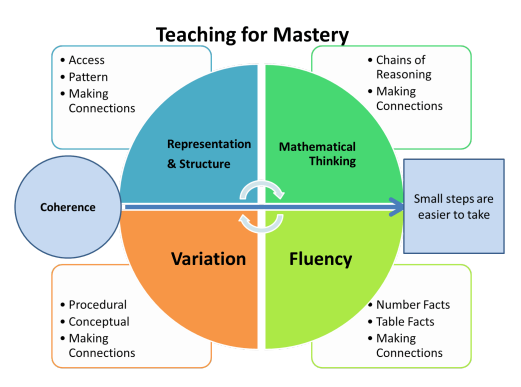
- Ensure a Mastery Approach: We have adopted a mastery approach to teaching mathematics, which means providing all pupils with the opportunity to achieve a deep understanding of mathematical concepts, skills, and processes. This will be achieved through careful sequencing of concepts, regular assessment, and providing extra support for those who need it. We use the 5 big ideas of Coherence, Fluency, Mathematical Thinking, Variation and Representation and Structure as vehicles to learning.
- Encourage Mathematical Thinking: We encourage our pupils to develop a positive attitude towards mathematics and to make rich connections across mathematical ideas to develop fluency, mathematical reasoning and competence in solving problems. We encourage the use of collaborative activities and peer discussion, allowing the children to communicate their mathematical ideas effectively and refine their reasoning.
- Use Real-Life Contexts: We provide opportunities for the children to apply mathematical concepts and skills to real-life situations, helping them understand the relevance and usefulness of mathematics in everyday life. The children are provided with various opportunities to apply their mathematical knowledge to other areas of the curriculum.
- Coherent Curriculum: Our inclusive, balanced curriculum ensures all pupils can access lessons which are appropriately scaffolded to meet the individual needs of learners through adaptive teaching (including pupils with SEND). This ensures that each child is challenged and supported to achieve their full potential.
- Develop Fluency: We develop our pupils' fluency in the foundational knowledge of mathematics, including number, geometry, measurement and statistics. We ensure that our pupils have a solid foundation in these areas, which will enable them to tackle more complex mathematical concepts in the future
By following these principles, our mathematics curriculum will provide our children with an enriching and engaging mathematical education which prepares them well for the successes in the next step of their learning journey.
Lessons follow a flexible, teaching for mastery approach, underpinned by the NCETM's 5 Big Ideas:
- Mathematical Thinking allow children to make claims reasoning connected with the other areas of their mathematics.
-
Representation and Structure ensures concepts are explored using concrete, pictorial and abstract representations, the children actively look for patterns as well as specialise and generalise whilst problem solving.
-
Coherence is achieved through the planning of small connected steps to link every question and lesson within a topic.
-
Variation is used within lessons both in pictorial representations and abstract tasks.
-
Fluency relentlessly focuses on number and times tables facts.
The teaching at Wawne Primary School provides opportunities for:
- Whole class learning
- Group learning
- Paired learning
- Individual learning
- Groupings/Individual learning with a teacher or teaching assistant



|
WPS Maths Policy September 2025 | [pdf 346KB] |

|
|
|
WPS Calculation and Representation Guidance Number & Place Value | [pdf 2MB] |
|
|
|
WPS Calculation and Representation Guidance Addition & Subtraction | [pdf 2MB] |
|
|
|
WPS Calculation and Representation Guidance Multiplication & Division | [pdf 2MB] |
|
|
|
WPS Calculation and Representation Guidance Fractions | [pdf 2MB] |
|