

Behaviour
Ready, Respectful, Safe
At Wawne Primary School, we want to create an environment that is safe, where everyone feels respected and where pupils come into each lesson ready to engage in learning. Everyone in our school is expected to maintain the highest standards of personal conduct, to accept responsibility for their behaviour and encourage others to do the same.
We recognise that each individual child is at a different stage of social learning. Only through a consistent approach to supporting their behaviour will we be able to achieve an environment in which children can learn and develop as caring and responsible people.
Our Behaviour Policy outlines the underlying philosophy, purpose, nature, organisation and management of pupil behaviour at Wawne Primary School. It is a working document designed to enhance the development of positive relationships between children, adults working in school, parents and other members of the wider school community. We adhere to the values of being: ‘Ready, Respectful and Safe’.

|
WPS Behaviour Policy and Procedures June 2026 | [pdf 1MB] |

|
|
|
WPS Anti-bullying Policy January 2026 | [pdf 182KB] |
|
Aims
- School staff use a consistent and calm approach, modelling desired responses at all times
- The school provides a safe, comfortable and caring environment where optimum learning takes place
- All staff provide clear guidance for children, staff and parents of expected levels of behaviour
- Ensure all adults take responsibility for managing behaviour and follow-up incidents personally
- Ensure all adults use consistent language to promote positive behaviour
- Use restorative approaches and appropriate consequences when dealing with incidents of negative behaviour
Our School Expectations
Expectations of Adults:
- Meet and greet every child, every morning
- Refer to being ‘Ready, Respectful and Safe’
- Promote our school values: Curious, Independent, Kind, Resilient, Respectful
- All school staff are expected to model positive behaviours and build respectful relationships with pupils
- Teachers use a whole class recognition system, to promote ownership of behaviours and reward positive behaviours seen throughout the school day
- All school staff challenge inappropriate behaviour and use a consistent and calm approach when managing behaviour.
- All school staff use consistent language to recognise and promote positive behaviour
- All school staff use restorative approaches when managing behaviour
Expectations of Pupils:
Follow our 3 simple rules:
- Be Ready
- Be Respectful
- Be Safe
Live by our School Values of being:
- Curious
- Independent
- Kind
- Resilient
- Respectful

Positive Recognition at Wawne Primary School
Recognition of good behaviour, achievement, attainment, kindness etc come in a variety of different forms and are given by all members of our school staff. Rewards must be attainable for all children and not just for a selected few. Rewards will never be taken away from a child.
The first and foremost form of recognition is through positive praise, enthusiasm, body language and oral recognition with feedback.
Specific rewards include:
- Name on the recognition board in the classroom.
- Dojos
- Class based rewards- an emphasis on everyone working together to achieve a class reward
- An individual token award e.g. Sticker.
- A visit to another member of staff for positive commendation.
- A public word of praise in front of a group, class, key stage or the school.
- Silver and Gold Awards for acts that demonstrate going over and above.
- School Certificates and awards, formally presented in the Celebration Assembly.
Class Recognition Boards
Good behaviour is recognised sincerely through Class Recognition Boards that aim to make good behaviour about relationships rather than a transactional act. The power of the group is at the core of this plan where adults notice and reward excellent behaviour that goes ‘above and beyond’.
Children’s names will be moved onto recognition boards when they have exhibited the target behaviour for that day or week. The target behaviours are linked to the Wawne Primary School Values. The aim should always be for the whole class to get on the board. in order to create the feeling of a team effort with the target chosen to reflect a behaviour which the class need to practise.
Our simple school rules and values are further explored and explicitly taught in class, assemblies and other school experiences.

Dojos
Positive behaviour will always be praised publicly at Wawne Primary School. All positive behaviours demonstrated by children on an individual basis are rewarded by staff with Dojo points. These can be given in class or around school. Dojos are issued 1 at a time in order to avoid behaviours being ranked in value. Dojos are displayed with the Class Dojo online system.
At the end of each day if a child has been placed on the Class Recognition Board for demonstrating the school value during the day, they will receive 1 Dojo.
Children who read at least 3 times during the week will receive 3 Dojos at the end of the week. This is to encourage pupils to carry out their reading practice at home to become more confident, fluent readers.
Where homework has been set by a teacher, children will receive 2 Dojos for the completion of this.

School Teams
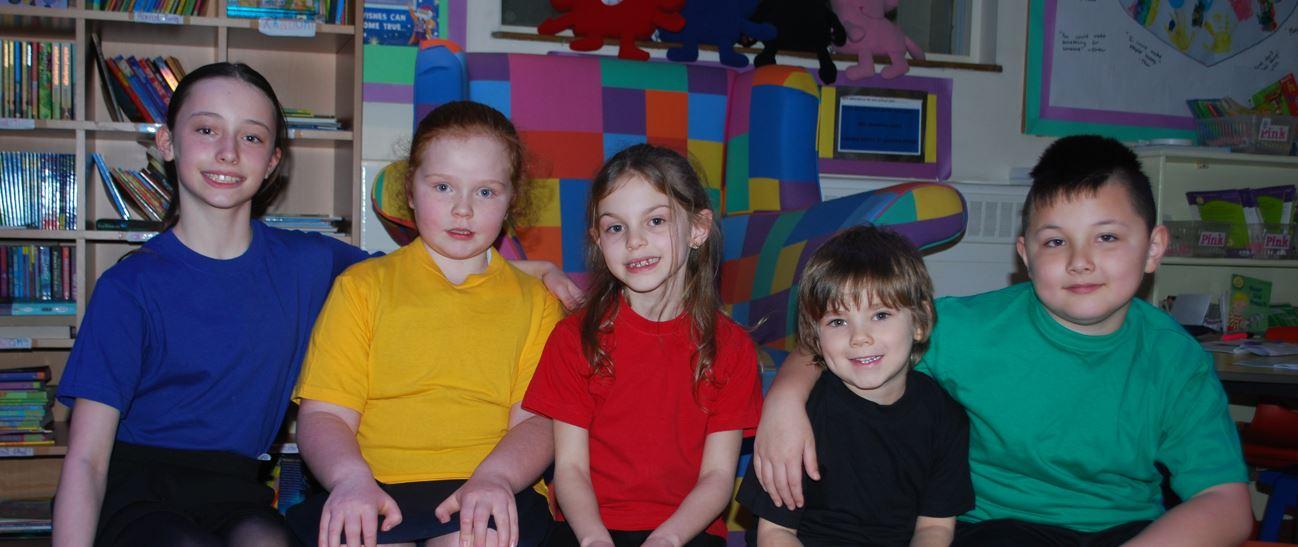
Every child and member of staff will be put into a team. Siblings will be in the same team.
The titles of the teams will be the colours of the Olympic rings.
Blue, Yellow, Black, Green, Red
- Each group of staff and pupils will wear their team’s colours on chosen days and events where they will be working together as a team. The team colours will be used for events like sports day, whole school events, PSHE etc.
- The number of Dojos earned per child each day will be added to their team score. A running total will be kept and the team scores will be announced in the weekly Celebration Assembly. At the end of each half term the team with the most Dojos will get to wear what they like to school on the last day.
Silver and Gold Awards- Over and Above Recognition
Children who demonstrate particular effort to go above and beyond in their learning or through a specific act will receive a silver or gold award.
For a Silver Award, the child will receive 10 Dojos for their team and a letter will be sent home from the class teacher.
For a Gold Award, the child will receive 30 Dojos for their team and a letter will be sent home from the Headteacher.
Silver and Gold Awards will be awarded during the weekly Celebration Assembly. Parents/carers will be invited by the school office to attend the assembly.
Children who achieve a Silver or Gold Award will be invited to sit on the Top Table during Friday lunchtime time where they will be able to dine in style.
Celebration Assembly
Each Friday the Headteacher will hold an assembly where the following achievements will be celebrated:
- Worker of the week
- Star of the week
- Headteacher Award
- Silver and Gold Awards
- Personal success (Outside of school achievements)
- Lunchtime Sports/Activity Awards
- Half termly reading cups
- Half termly outstanding achievement cups
- Half termly Courtesy Trophy
Restorative Approach
‘Punishment doesn’t teach better behaviour, restorative conversations do.’ Paul Dix.
Pupils are taught that every adult in our school has the ability to deal with behavioural incidents. If an incident takes place in the playground, this will normally be responded to by the lunch time supervisors who use the same approach as teaching staff. This allows an intervention to take place immediately and may involve a restorative conversation. In order to reduce the impact on teaching time, support staff and leaders will be expected to release the class teacher if a restorative meeting is required.
Restorative Meetings and Conversations
‘The positive relationships you form with pupils depend on a restorative approach being your default mode.’ Paul Dix
At Wawne Primary School, we believe that nurturing and restorative practice, as well as high expectations, are key to building positive relationships. Restorative meetings and conversations aim to help the child realise how their behaviour impacts others, teach what appropriate behaviour looks like and equip the child with the tools they need to avoid similar incidents occurring in the future.
Restorative Questions
Restorative questions are used to support post-incident meetings and conversations. Pupils are coached and encouraged to take responsibility for their behaviours. They work with a member of staff to understand why their behaviours are not positive, then decide how the pupil can put things right and react differently the next time. School staff can use the appendix questions as a guide, depending on the child and the situation, using their professional judgment to lead the restorative conversation.
Consequences
At Wawne Primary School we encourage positive behaviour that reflects our school vision, aims and values. Our behaviour management approach is based upon building strong relationships between adults and children. The use of positive reinforcement strategies will always be our default approach.
If a child is not responding to these strategies, there are clear, consistent consequences chosen by the adult dealing with the specific incident. These are designed to hold the child accountable to our high expectations. Pupils are reminded that after every incident it is a ‘fresh start’ and they are coached and encouraged in how to put things right and respond differently next time. Consequences always encourage the child to reflect on their behaviours and, through a restorative approach, encourage the child to make good choices in the future. Consequences need to be immediate, short and appropriate for the behaviour and only aimed at the behaviour not the child.
Stepped boundaries:
Redirection, Reminder, Caution, Reflection Time, Repair, Formal Meeting
Extreme Behaviour
Some children exhibit particular behaviours based on early childhood experiences and family circumstances. As a school we recognise that their behaviour is their way of communicating their emotions. We also understand that for many children they need to feel a level of safety before they exhibit extreme behaviours. Where possible, we use our most skilful staff to build relationships with each individual child.
These children will have bespoke behaviour plans / behaviour contracts.
The school will record all serious behaviour incidents using school
Exclusions will occur following extreme incidents at the discretion of the Headteacher.
We understand that throughout this process, it is imperative that we explain what is happening and why it is happening to parents and arrange meetings to discuss.
Serious Behaviour Incidents
Any of these behaviours will result in an instant move to Reflection Time as well as an additional consequence specific to the child and behaviour which will be decided by the class teacher in conjunction with the Headteacher.
These behaviours include;
- Violence (i.e. physical contact made with the intention to harm)
- Defiance / rudeness towards any adult
- Persistent taunting, teasing and bullying behaviour
- Stealing
- Spitting
- Swearing
- Derogatory language or behaviour
- Intended damage to property
These serious incidents will also result in either a phone call home from the class teacher, or a face to face conversation between the parent/carer and class teacher at the end of the day. (Depending on the severity, this may be from the Headeacher or a member of SLT) All incidents should be recorded on CPOMs.
Physical Attacks on Adults
At Wawne Primary School, we take incidents of violence toward staff very seriously. We also understand that staff are the adults in the situation and can use a ‘common sense’ approach to keep themselves and the child safe to manage the situation effectively. Staff can use ‘reasonable measures’ to protect themselves in accordance with the DfE guidelines on Physical Intervention and Use of Reasonable Force and should call for support if needed. Only staff who have been trained in physical restraint should restrain a child.
All staff should report incidents directly to the Headteacher and they should be recorded on CPOMs. We appreciate these incidents can cause distress for the adults involved, therefore all staff are entitled to take some time away from the classroom to recover their composure. In extreme cases, the member of staff may be allowed to go home by a member of SLT.
Whilst incidences of violence towards staff are wholly unacceptable, we must remember that we are a nurturing school that values each child under our care. Children who attack adults may do this for several reasons but as adults we need to still show compassion and care for the child. However, exclusion will be considered to enable exploration of options and the creation of a plan around the child.